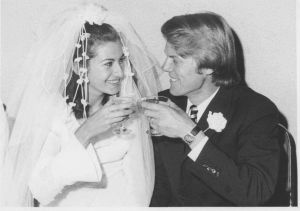
Freelancer - Denis Hutchinson


Independent, honest, straight down the line and a gentleman through and through are words that describe eminent lighting designer Denis Hutchinson, known as “Hutch” by his friends. 

He was schooled in South Africa and his interest lay from aeronautic engineering to psychology. “The thing I never thought of was probably the thing I’d have been good at and that’s architecture,” Denis says.  “Architectures loss was theatres gain. Or should that be the other way around?”

While many famous sports stars follow in their father’s footsteps - one only has to think of cricketers Graeme and Shaun Pollock, rugby stars Ruan and Geysie Pienaar, the Senior and Junior Schalk Burgers or even now recently in South African music, Johnny and Jesse Clegg – Denis stepped out of the mould, his dad being the successful golfer, also Denis Hutchinson, and achieved distinction in his own field..

His early years were magical as Denis and his mother travelled along with his dad on the European and South African Golf Tours - chasing after summer. Denis says to this day he does not do winter very well! “Being ‘on tour’ I grew up surrounded by adults,” he recalls. “Only when I started school did I come into contact with kids my age.” Because he literally grew up in hotels, he tours easily but did, however, miss out on certain things. “Balls skills were skipped,” he smiles. “You can’t catch and throw in hotel rooms and I’m not a great golfer either!” Yet this unconventional start, produced an eloquently spoken young boy, confident, passionate and with a background that would compliment his interest in the arts.

At age ten, Denis lit his first show. “Very badly, I have to add,” says Denis. “I think it was more a fascination with the switches but that was the start.” It was for a school play and Denis focussed four lanterns. This led him to read up on the subject with a continued interest throughout his school career. Ironically, having signed up to light ‘Twelfth Night’ when he was in Standard 6 (grade 8), he got dragged into auditions and was eventually told that he could light the show, if he was also prepared to play the role of Feste. “My first taste of emotional blackmail in the theatre!”  Throughout his high school years he bugged all the theatres like the Alex and His Majesty’s in Johannesburg and helped out on weekend set-ups. “I worked for free in Standard 9 and 10, but as a means of learning it seemed the obvious thing to do. And there was a payoff - I got to know people in the industry and got offered my first paid job just after I’d finished matric. I was asked to take over the Stage Electrics for “The Great Waltz” at the Civic while the normal guy was on leave. They paid me the princely sum of R45 per week.”
A Handful of Keys - the new touring version (set & lighting)

That was a far cry compared to the salary paid at what Denis calls “Uncle PW’s Holiday Camp for Wayward Boys”, otherwise known as the army. Doing his basics at Heidelburg and posted in Cape Town he was paid R28 per month. “The army did give me a uniform, board and lodging,” he jokes. And during this 18 month period he managed to light a few shows for amateur companies in Cape Town

In the army Denis presented training on how to fix radar. “I ended up having a good time and thoroughly enjoyed it,” he recollects. “I taught in both languages and in the last course only in Afrikaans. Ironically I have only worked in Afrikaans in the theatre twice in the last thirty years. I always thought this a great pity.” His first engagement after the army was the Afrikaans version of “Boeing Boeing” with Frans Marx, who back then was still an actor. “Egoli hadn’t been thought of and I was employed as the ASM. When the Stage Manager fell ill, I became the Stage Manager.
 
He then worked for the Circus Osler which played 14 shows a week at the old arena in Johannesburg and thereafter he was employed by Joan Brickhill and Louis Burke from His Majesty’s on their production of ‘Grease’. “We did rock and roll on a Grand Master… it’s the most fun you can have on a lighting board,” says Denis. “It’s hard to explain but it’s a real manual board and two of us used arms, hands, knees and elbows for complex lighting.” Denis recalls that the board made use of two operators. “We used to sweat more than the dancers!”

When the production moved to the Nico Malan (now Artscape) in Cape Town, the lighting had to be transferred onto a (then) brand new MMS control desk. “We had to cut cues because there were things the desk couldn’t do. It was only one cue at a time, and if you wanted to do multiple timings… well, you couldn’t.”

A Handful of Keys, the original version (set & lighting)

Denis says that it’s easy to forget how this industry has develop
ed over the years. “I grew up with the Pattern 23 which was the Source Four of its day. The idea of moving lights was virtually the stuff of science fiction,” he says. “While there was a colour change mechanism in the early 30s, a moving light was a followspot. The earliest moving lights I can recall were some fresnels from the early 70s which could only pan, tilt and focus. Back then only the big German theatres could think of using them and there certainly weren’t any to be seen in South Africa.”

“Real Moving Lights really started with the early Vari*Lite developed for one of the early Genesis tours and it was a good ten years or so before they arrived here and even then they were only used for rock concerts, because of the noise they generated. The first moving light that was really good for theatre was the VL5. It was a quiet fixture and had a degree of accuracy – and sadly never made it to these shores – at least not into our theatres.”

Technologically today, it’s a whole new ball game with moving lights the norm and video steadily working alongside. And with all the toys Denis believes SA designers are much underrated. “Almost without exception we work with a smaller budget and less gear, yet produce results,” he says. “In a lot of areas overseas designers are spoilt for choices which is a problem we certainly don’t have. Of course I don’t know if I’d know what to do with all of that extra if I had it!”
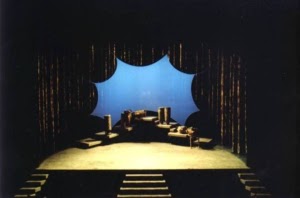
Umoja - Shaftesburty Theatre London (set & lighting)

That said Denis would still like to find a show to light with one lamp. For him he’d rather light Shakespeare than play with all the toys. It’s the verbal moments, the use of language, that has moved him most in theatre and some of his most vivid theatrical memories happened in the rehearsal room without any of the ‘extras’. “It’s all about the performance and the way in which the audience are involved. The real things are important, the raw emotions. All too often the drama can be swamped by extraneous effects.”

Denis keeps up with technology but does not want technology for technology sake. “There is some awesome new technology, but  I’m not sure that the theatre – where I spend most of my time – is not going to head in the direction of simplification even with the use of new toys. I think the strength in theatre often lies in simplicity and allowing the audience to use their imagination.”

Lighting aside, the love of words in scripts have kept Denis going and staying in the industry through the years. Outside the work place he enjoys travelling, scuba diving and used to do sky diving. “I love going to the movies, listening to music (usually older than I am!) and reading… In fact I will read just about anything including the backs of cereal packets!

With all this said, one would imagine Denis to be a real home maker, arty, creative and his dwelling place to be something you’d page through in a home magazine. “For me home is about comfort and being able to relax. I look at beautifully decorated homes, and they are gorgeous but I’d be too scared to put my feet up on the coffee table and that’s so not me!”

Contact Details:
 
Cell:                            082 556 0718
Company Fax:           011 616 6169
E-mail Address:        dhutch@telkomsa.net

Events and Installations - Claire Robins


We know Claire Robins as the person behind Events and Installations, a magazine covering the South African entertainment and events industry news. Her life in theatre, however, has been remarkable and you may just look at Claire with different eyes when hearing her story..... if only we could write a book instead.

 
Claire was born in England where she lived in Clifton, Bristol and attended school at Bedministerdowns. Her earliest recollection of theatre was at the age of six, when her parents took her to the ballet.  “That was the end of me,” recalls Claire. “The music was a world of magic.” She would dance in front of her wardrobe mirror, the radio playing in the background, and demonstrated her natural flair on stage when taking part in an Irish Jig at school. When her co-star “leprechaun” was overcome with stage freight, young Claire improvised and ended up doing the scene by herself.
For her 11th birthday, Claire’s father gave her a special gift. “It’s something you can’t touch or see,” he gently explained. To her delight, he had signed her up for ballet lessons. She later received a scholarship to attend the Ballet School in London, moonlighting in clubs and musical theatres.
Then Claire got married. “I was 18,” she recalls. “I thought it would give me career freedom. An Australian Duty Director for tv shows like Coronation Street, her husband longed for sunny barbeques and his mates back in Australia. He was reemployed at an Australian television station and no longer expected Claire to continue working in the theatre.
Claire Robins as Potiphor's wife in 'Joseph'
 
Claire could not get her head around this. Invited to attend a dance class, she was approached by the choreographer directly afterwards. “I’d like you to be in a musical we are doing called Funny Girl,” Betty Pounder said. Young Claire packed her bags and toured Australia for the next three years. Claire and her husband met up again, he arriving one night after a show around a year later. He wanted her back but said things would not change. “That was a no brainer for me,” says Claire. They were officially divorced seven years later.
 
In 1968 Claire left Australia for England by a ship which was destined to stop over in South Africa. A monsoon forced the vessel to dock in Durban. As Claire stepped onto African soil, she was taken aback when an older gentleman from African Consolidated Theatres was there to meet her. He was the father of someone she had met in Australia. “My daughter said you were coming,” he said. He had arranged accommodation and took her to the opening of ‘La Traviata’ that night. There she met Ronnie Quibell who was producing the musical ‘Daddy Longlegs’ and he asked Claire to be part of the production. Claire opted against it.
She bought a VW Beetle in good nick and eventually travelled to Johannesburg with the names and telephone numbers of theatre producers like Pieter Toerien, Brian Brooke and Hymie Edwin.
Claire had tea with Pieter Toerien on her first day in Johannesburg. “We need someone like you in South Africa,” he said. You should go see Brookie who is casting a show.”
The next morning Claire called Brian Brooke, went to his office at 10am and by 10h30am had started rehearsals for the show. She found herself under Brian Brooke’s wing, he found her a flat, and she along with the cast, enjoyed lunches at his home and skiing at the Vaal as one of the family.
Taubie Kushlik asked Claire to understudy the lead in her production of Cabaret. “She wanted to cast me for two and six and as much grass as I could eat... I couldn’t afford to work for pocket money,” remembers Claire. She was then offered a job at the Adam Lesley Theatre. “Adam was a satirist and all his musical reviews had a satirical bent.”
Claire stayed with Adam for a year, and after 18 months in the country she returned home to England in December 1969. “I hated it,” confesses Claire. “I was a bit horrified, shocked, that a lot of my peers were on the dole. I had been half way around the world while they sat with their feet up, some of whom had the same education as me. The theatre was in the doledrums.”
 
 
Claire stayed in England for 15 months. She bumped into an old acquaintance who needed a replacement in a show called ‘Oh Calcutta!’ Says Claire, “It was a very naughty show. I went to the theatre and saw the first half and then left. I didn’t want to dance around the stage with nothing on!”
 
During her time in England, Claire did everything except working in theatre. She deliberately avoided it to explore any other avenues. Then one day she received a telegram from Adam Lesley asking if she would come back to South Africa immediately for a show. “You’d better go,” said her mom. “You’re not happy, as much as I would like you to stay.”
To Claire South Africa felt so free in comparison to London, it certainly did. “The strange thing was, South Africa gave me the freedom I didn’t feel I had in England,” she said.
Travelling through country with Adam Lesley’s show ‘Sweet Fanny Adams’, Claire performed and worked as show assistant director. “The performing side eventually became less important,” she says.
Many other productions followed such as ‘Straight Up’  with English Director Frank Shelley, ‘Manners and Morals’ for Geoffrey Sutherland and ‘The Best of Birds and Beasts’ for Robert Kirby.
Louwrens Snyman with Claire at an opening night in 1982
 
At the end of 1973, Geoffrey Sutherland was casting a production of ‘Joseph and the Amazing Technicolor Dreamcoat’ being staged in South Africa by Louwrens Snyman for PACT (Performing Arts Council of Transvaal). Nobody had an inkling of the phenomenon it would become.
 
“Louwrens wanted me to play Potiphar’s wife in the show,” said Claire. “I didn’t really want to do it, but he would not take no for an answer. For such a small role in the show, it would be like taking a step backwards.”
 
 Joseph was only scheduled to run at the Alexander Theatre in Braamfontein but from the opening night it was huge. “It became an animal,” says Claire. “Families would follow the show, they would pitch up for the production all over the country. We had more fun than anyone deserves.”
 
Over the years that followed Louwrens Snyman made sure Claire kept working in every show he could. “I used to always perform in a show and act as assistant director. My life was the theatre, it was like a family, but most importantly I loved and respected the technicians but they never got the glory.”
Financially, with the future in mind, Claire became concerned. “At that stage I was approached by one of the Directors of Anglo American Properties, a man by the name of Nigel Mandy in 1981,” she says. Claire was appointed as PRO for all the Anglo American’s shopping centres. She remembers him saying, “You qualify because you have a degree in abnormal psychology... you’ve worked with actors and musicians.”
Nigel Mandy gave her invaluable guidance to running a business. “Nigel taught me to invite the Chief Fire Officer to breakfast every month, and walk around the centre, recorder in hand, taking notes of the meetings. He in turn would tell us what we could and couldn’t do for the next event...that was Health and Safety in 1981. It was critical then, and people think it doesn’t matter these days.”
Still running the shopping centres, Claire continued doing the odd production and one day received a phone call from Louwrens Snyman, who said, “I need you for the opening of the Pretoria State Theatre.” PACT would showcase all the performing arts, including Joseph.
At the end of that year, the much loved director of PACT, Eghard van der Hoven, retired. This was devastating news and many members of the PACT fraternity feared for their future. Nick Michaletos and Rudi Kesting left to form Production Projects and Louwrens approached Claire to form a partnership to create a new production company and asked her to find a backer.
Claire approached Herman Youngleson, who was head of Kinekor (now Ster Kinekor) for financial backing and they formed International Players and Theatre Production (IPTP). David Land, the agent for Andrew Lloyd Webber and Tim Rice, furthermore supporting the new company, promising them future rights for all their productions. “But first of all I want you to do Joseph again,” said David Land.

“We agreed and asked Nicky and Rudi to supply the set and full technical production for the show which would open at the Alhambra Theatre in Durban,” said Claire. “Their quote for the entire job was R20 000.”
 
At that stage Claire was 34. She resigned from Anglo American and started working on their production of Joseph. “We knew we had to be careful with the budget and from what I’d learn regarding sponsors as a PRO, I got hold of Gilbeys who owned Douglas Greene. We negotiated that we would have a scene in the show that was branded with their products. Another sponsor was Adidas who supplied Joseph brothers’ costumes for the show. “Purist turned up their noses, but the sponsors enabled us to afford the show.”
 
After opening in Durban, Joseph was again a huge success. Then came the phone call. Marloe Scott-Willson, who was playing the narrator, had been involved in a serious motorcycle accident along with her fiancé.
Claire’s experience always emphasised the importance of an understudy. The accident was a huge blow but the show was able to continue with Alvon Collison as Narrator.
The show closed in Durban on the Saturday night and was moving to the Johannesburg Civic Theatre when tragedy struck again. That Sunday morning the phone rang at Claire’s home in Johannesburg. It was the Warden Police notifying her that there had been a car accident in which two of the cast members, Kritch Krook and Janine Bowen, had died on their way back to Johannesburg.
The next day it was in the press: ‘Jinx of Joseph’. Regardless, Joseph opened. “It was not the ability to cruelly dismiss and disregard, I just couldn’t afford to be in shock, “ remembers Claire. The cast had met and were given the opportunity to cancel the show but had jointly decided to carry on. “We had a new Narrator, Kim Kallie,  a beautiful blonde girl who looked like an angel, to open the show the show in Johannesburg. “I don’t think anyone in the audience could believe what they were seeing,” says Claire. “There was a standing ovation.”
 
The show was scheduled to tour the country and Claire left Johannesburg to visit the relevant theatres to sort out ticket sales and checking the technical side of things. “In my absence, Herman Youngleson got cold feet. He said to Louwrens he couldn’t go on with IPTP.”
Claire reminisces, “There really was no need for us to close, but by the time I returned the “notice” was up: The run of Joseph would come to an end in two weeks time.
 “I was a very even tempered person in those days but I flew off the handle. IPTP was a dream come true for Louwrens and I, we had everything going for us.” 


Within a few days, a friend asked Claire to produce and direct a show for the launch of the  Hyperama supermarket which was to be held at the Civic Theatre. “So in 1982 it became one of the first companies to launch a theatrical production for a major corporate event.”
 
Louwrens in turn went off to run The Magaliesburg Country Restaurant. Claire was contracted to create an event for the opening of the Menlyn Park Shopping Centre in Pretoria which included setting up the marketing, advertising and buying of capital equipment for events. Thereafter she was approached to run a company that created computer generated images for event presentations.
“It was 1984 and out of the blue I received a phone call from Louwrens who was in Johannesburg and wanted to meet up with me” said Claire. He wanted to rekindle our partnership and to start producing productions again.
After discussing the feasibilities of doing so we decided to go ahead. We arranged to meet the following Sunday morning to finalise our plans. “At 8am on the Sunday morning, two friends or ours arrived at my place in Westdene with tragic news. Louwrens was dead. A gang had arrived at his brother’s club the night before searching for someone – when Louwrens intervened he was shot.” Claire was in shock. 

At a TPSA event, Claire, Stephen and Alvaro Rodrigues

Skip a year and Claire was convinced to go back into acting. She wasn’t yet forty when Pieter Toerien asked her to do a play called “Stepping Out”. Whilst attending the opening night of another of his productions, Claire was approached by a young 15 year old girl, who said, “Claire, do you remember me?” It was Suzie Collins, the daughter of Val Dunlop with whom Claire had appeared in a play. “I’m here with daddy,” Suzie added, then dragged Claire off to meet her dad Stephen, a now well known technical production manager. “We’ve been together ever since and I’m enjoying live as a ‘grandmother’ to Suzie’s children,” smiles Claire.
 
“Over the years I have had to reinvent myself. With Stephen constantly away on events, I looked for a new avenue of work. After working for two publishing companies, I started Events and Installations, my own magazine, in 2000, which still continues to this day.”


DWR Distribution - Dan Riley

Neil Daniel Riley (Dan) comes from an era were one of his first salary cheques, or better put, salary envelopes for the week ending 15 January 1959 was to the value of ₤3.56! At the time he was employed by electrical contractors, P.G.M. Magnusson, where he was completing his electrician apprenticeship. 

Dan and Linda make the most of every opportunity
to get away. Pictured here in the Wilderness.

Career History

One must realise that in 1970 it was not necessarily conventional to take a position in stage lighting. In South Africa a steadier career choice may have been teaching, working in a bank or joining a mine. 

The early days, Danny with sons Bruce (in pool),
Duncan (far right) and family friend Jose.

Without realizing what the future would hold, and that this step would influence his life as well as dictate the career in which his sons, Duncan and Bruce, would follow, Dan took up the position as a Sales Engineer at the G E C Lighting Department who had the Strand agency. Besides the general sales, planning, tendering and service he provided, he was sent off on a plane, destination UK, for training on a new control board that was based on computer technology. No mean feat for the time!

It’s interesting to read Dan’s Curriculum Vitae, to see what assignments he worked on. To think that while many of the current industry leaders, consultants and LD’s were still in nappies at the time (or learning to walk), he was completing projects at the Bloemfontein Civic Theatre, Port Elizabeth Opera House, Klein Teatre – Windhoek, Alexander Theatre, Intimate Theatre and the Breytenbach Theatre 

A passion for show-jumping, this photo of Dan was
taken in 1972.

When the G E C Lighting Department was taken over by Rank Strand Electric in 1975, Dan was requested to move with the product Strand – a brand Dan became synonymous with over the years.

Work continued as normal, but the clientele increased with work also done at the Hexigon Theatre Pietermaritzburg, Performing Arts Council of the Transvaal, University of Pretoria, UNISA, University of Potchefstroom, Nico Malan Theatre, Baxter Theatre, Alambra Theatre and Market Theatre.

Then in around 1978 Rank Strand handed over distributorship to ACF Merchandising. Again Dan was asked to move with the Strand product. He did so and became involved in advising architects and consulting engineers regarding general stage lighting technicalities. Projects included the Vereeniging Civic Theatre, Sun City, President Hotel, Landdrost Hotel and the Holiday Inn Maseru.

It was touch and go for Dan in 1979, where the industry could have lost him to the world of boreholes! Dan started his own company called “The Pump Doctor” fixing boreholes and performing general maintenance and electrical work. It didn’t last long, around a year, after which he joined a company called Afitra.

Dan worked at Afitra, employed in a sales position. He imported and exported products to and from Israel, USA, Belgium (the ADB range), Holland and Germany. He assisted in customs and finance, and found agencies for products such as starter controls for motors, solar heaters, industrial dishwashers, security fencing, cables and even some stage lighting equipment. It was not his passion and he only stayed for a few years before going back to ACF Merchandising Zumtobel who then had the Strand agency.

Zumtobel sold their Strand agency to Calite, and Danny and Strand continued their walk together. Dan stayed at Calite from 1993 to 1998.. While Strand had progressed through the years and new products had entered the market, a new generation also evolved. They were the young Mick Landi (Shattered Glass), Mark Gaylard (MGG), Kurt du Preez (Upstage), Mike Jones (MJ Event Gear), Pierre Griffeon (Pure Sound) to name but a few. Some of them were starting off as mobile disco companies and hiring and buying equipment from Calite. All of them are now some of the most successful rental companies in SA and Dan watched and provided a service to them as they grew in stature.

From 1999 to 2007 Dan was employed at Electrosonic SA. Danny had Strand come with him, and also played a role in getting the Compulite agency. He continued to serve the industry and being involved in sales and back-up.

Lourie Coetzee, owner of Electrosonic SA was once overheard saying, “Dan is a legend of his time in this field”. Perhaps this is true, but the truth also is that Dan wouldn’t want all the fuss and attention focussed on him.
 
Dan joined DWR Distribution in September 2009 and it has been wonderful having him in the office.
 
Looking back though, his memories must be endless as he formed part of a special group of people who really love what they do, those they work with and an industry they served. It’s a vibrant industry with constant change, creative minds and where relationships still seem to count.

Dan the man

Always a constant, you can be assured that when you’re in Dan’s company you will be met with a huge smile. He may joke and tease, but there’s a sincerity and interest in what you are doing and how you have been keeping.


As a family man, there could be no better. Married to Linda, the couple fell in love when they both participated in show jumping - within six months they were married. They lived on a farm in Lammermoor, kept their horses and weekends were dedicated to shows… that is, until their two sons Duncan and Bruce came along. The boys were not interested in horses at all! Another family outlet had to be found. Dan and Linda bought motorbikes, and each parent drove with a child behind them.

After the bikes it was trying their sea feet with a rubber duck as they enjoyed trying their skiing skills or pulling a tube behind them. 4x4ing was also part of the fun.

These days, Dan is also known as “Grandan”, a much loved grandfather as well as a wonderful husband, special dad and father-in-love (law). Weekends are reserved for Hartebeespoort Dam, where friends and family are always made welcome at their cottage and given a boat tour of the dam. You often see Danny and Linda shooting off on a jetski, and one thing is certain, they know how to live life to the full.

Dan trusts in Jesus as his anchor and through the years, along with Linda, has always helped those in need and have encouraged people they meet to have a positive outlook on life. You won’t meet Danny without hearing laughter. It’s his very nature that has made him so likeable and loved both at home and by the industry he loves too.

Contact details:
Tel: 011 793 5066 

Digital Fabric - Gavin Olivier

Gavin and Miranda Olivier

Enter Gavin Olivier and you’ll immediately set him apart even if you’ve never met. He’ll be the guy dressed casually yet with flair, and if you are meeting to do an installation over a weekend, you can trust Gavin to bring along the croissants and most certainly hot, strong coffee. In fact, he may just call the meeting at Vida-E.

In 2004, after 13 years at Electrosonic, Gavin took the plunge and established Digital Fabric, working on a consultancy basis. “It has been fantastic,” says Gavin. “I get up every morning and say a prayer of thanks. This has been the single most enjoyable years of my career. I enjoy the freedom of doing what I do and it’s very rewarding.”

The Mining Heritage Tour

In a short few years, he has played an influential role in the creation of many of the countries top Visitor Attractions and Museums. “I have worked on projects from remote locations as far north as Limpopo all the way down to Cape Town, with the subject matter being as diverse as the geographical separation.”  These projects have included Africa’s first ever 4D Theatre, De Beers World of Diamonds in Kimberley, Origins Centre at Wits University, The Apartheid Museum, and SAB’s World of Beer to name but a few.

While initially consulting on audio visual hardware, Digital Fabric have broadened their horizons and now play an increasing role in the conceptualization and planning of projects. The technical scope is also increasing and more often than not includes lighting and interactives. “It’s a logical progression really” says Gavin. “In my line of work the technical process is integral to the core concept so inevitably I am involved from early on. I’ve also been loving the interactive development, there are some crazy ideas finding their way to reality and each one is entirely different from the last. It’s nice to be doing stuff that is unusual or unique, that’s what Digital Fabric is all about”.

This niche market sector has proved to be very rewarding. Here it’s not about putting up loudspeakers in a corporate environment where nobody notices them, or hanging up a flat monitor in a boardroom. Attention to detail is paramount with the main focus being on how the audience will perceive the end message, be it to gather information at a museum or to experience a fantasy thrill in an entertainment venue. Where loudspeakers are mounted, how a monitor is selectively placed in an exhibit environment  to create visual appeal and the choice of equipment down to the last detail, makes the projects all the more purposeful and rewarding.

More recently, Digital Fabric has been appointed to projects like the Liliesleaf Heritage Project in Rivonia, Freedom Park’s new museum wing \\Hapo, the Nelson Mandela House Project in Soweto and a very exciting mining museum project close to Sun City.

How it all began
Sound Engineer at work
 Stepping back in history, Gavin attended Sir Pierre van Ryneveld in Kempton Park and then began an apprenticeship in electronics. “I was always keen on audio and especially wanted to be a sound engineer,” he says. “I was involved with doing sound anywhere I could.” The apprenticeship with STC (Standard Telephone and Cable) served a good purpose providing a solid background in electronics, but the monotony made it impossible to stay. After a stint in the army and two years working on computer mainframes, an opportunity arose at a small audio PA rental company, Evergreen Productions, for half the salary. “It was a way out of the rut at that time and a way into the industry. We did a lot of local stuff, jazz items, with a mostly dodgy audience. It was in the bad days when if Brenda Fassie didn’t pitch up to a gig the audience would burn down the rig,” he smiles. “It was gritty, low budget stuff and I loved it.” Evergreen Productions also made flight cases for the bigger rental companies of the day, like Robbie Bailey who owned Sound Scapes. “Lighting wasn’t a big thing in those days. The idea of corporate events as we know them now didn’t even exist.”

A big rig for Gavin in the 80s

Thereafter, taking a sabbatical from the sound industry, Gavin spent a year of his life building beach buggies with a friend. “We were building really top quality buggies, built from scratch on old beetle chassis’.”

In 1993, at the same time Gavin was about to get married, an opportunity knocked in the appearance of an advert. “The position was for a small, new company in the form of Electrosonic, and the rest is history,” says Gavin. Most of the industry has come to know and respect Gavin from Electrosonic SA days, where he played a prominent role in building the business and expanding the Crestron and Kramer product ranges and was involved in significant projects and installations.

“Electrosonic was a year old then and there were only four people, Lourie Coetzee, Bruce Genricks, Gizelle Coetzee and Grant du Preez. I was the fifth member of the team and we had exceptionally good times. In those early days Martin Professional made disco stuff, dodgy mirror lights. CRT Projectors were the only projectors arriving long before LCDs, and it was the day of the legendary Celco Gold lighting console, Ofer Lapid still has one embedded in his boardroom table. Electrosonic grew from a small company to a premier company in the South African market. We had big milestones like ICC Durban, which was 13 months of solid work.

 “The beauty of working then was that we never did the same thing twice. We would do a video wall one day, sound the next. We were in a top bank boardroom one day, and then taking a projector down with a scaffold at a nightclub the next because they hadn’t paid us,” he laughs. “We really paid our dues like driving to Durban to do an installation, and coming home the next morning at 3am. These days you fly and stay over. In a way things were simpler in those days but you did seem to work harder for your money.”

Gavin with his boys Peter (front) and David

Today, with Digital Fabric fulfilling Gavin’s passion for design and love for people, any spare time is reserved for his wife Miranda and their two sons David and Peter. The young boys jump at the opportunity for adventure, and whether it’s camping in Sabie, visiting the Kruger Park, or just enjoying shopping with their dad, it’s clear to see that theirs is a close knit family. On one particular occasion, Gavin walked through an upmarket decor outlet with his two sons. On the wall hung an oil painting of a semi-nude woman, her derriere only partly covered by a swag of cloth. Not one to miss anything, Gavin’s youngest son Peter shouted out “Look at that plumbers crack”, much to the amusement of the surrounding Saturday morning shoppers.

Miranda recently asked Gavin what five dreams he would still like to achieve in his lifetime. Content as he is, he came up with a few. “I would like to live by the sea in a simple house that overlooks the ocean. I also intend to design a living museum in South Africa, something meaningful, from scratch.” Oh, and a Porsche Cayenne wouldn’t exactly hurt either.”


Contact Digital Fabric

Mobile: +27 (0) 82 927 1475

Custom Gobos - Andrew Muller


If he was not wearing a helmet, Andrew Muller, owner of Custom Gobos would have the wind in his hair delivering gobos on his motorbike and a typical onlooker may think, “Now there’s someone who’s got it made.”

With hardly any competition, it would appear that Andrew is in a league of his own. Offering a high tech product  and service second to none, he can be excused for upping his price on a rush job. One thing’s for certain though… he always gets the job done right and on time. Take the time to visit his website gallery, and you realize that gone are the days where gobos were just metal stencils. Today with colour and laser you can just about create a painting on something that is not much larger than a five rand coin.

But life in the fast lane did not fall into Andrew’s lap. Douglas Franklin* once said, “My theory of self-made men is, then, simply this; that they are men of work. Whether or not such men have acquired material, moral or intellectual excellence, honest labour faithfully, steadily and persistently pursued, is the best, if not the only, explanation of their success.”

With his offices based at his home in Highlands North, Johannesburg, Andrew lives one street away from his parent’s old home. “In my late schooling years, I started a little disco. I got into sound early and started doing school parties in garages,” he reminisces. With only a couple of speakers he got the job done.

Andrew, 8 years old at the time

Andrew completed his matric through Damelin and then worked as an apprentice mechanic for Toyota Rivonia. Realizing that he needed theory as a back up, he completed his N3 Motor Trade Theory at Wits Technicon. Then in the middle of winter, in July 1984, the South African Air Force beckoned and Andrew found himself at Mariepskop where he became a Radar Operator.

Returning home two years later, Andrew worked as a programmer and assembler in the R & D Department for a company called Computer Sciences, running a mobile disco on the side. “It was tough,” he says. “Every cent I put into the business and I wasn’t making anything. I couldn’t even afford to advertise in a newspaper!”

A company who did advertise on a daily basis caught Andrew’s attention. Exasperated, Andrew phoned them – Cream Cheese Discotheques – and spoke to owner Colin Slater to find out how they managed to afford the constant advertising. Colin, in turn, invited Andrew to come and see him. “I bought a pair of shoes for the meeting because I always used to walk around in a pair of tekkies,” says Andrew. “On that day, my dad was working on a car and commented on my nice shoes, warning me to watch the oil pan. I don’t know how I did it, but I stepped into the oil pan and ended up going to the meeting in my old tekkies anyway!”

Colin Slater was always on the look out for new DJs, and Andrew, who found himself retrenched after a year from Computer Sciences, was now spending more and more time at Cream Cheese. In those days you had to work as an apprentice before becoming a DJ and Andrew was initially hired to set up and collect gear before he could do his first gig – which ended up being a matric dance at Northview High. 


At that time Strike Productions was new and also belonged to Colin Slater. “David Hossey was a DJ, and suddenly Colin had to buy stages and lights – it was early days for rental companies – and David ran the sound, Colin did the lighting and I drove the gear, helping to off-load and set up.”

On a day Andrew was at the Johannesburg Sun sitting behind a control desk at a fashion show. “It was a Zero 88, 12 channel manual light desk and I’m not sure what happened, but I had been watching rehearsals when Colin went out. It was in the day before cell phones and Colin went back to the office to make some calls. The client asked me to run a couple of scenes, and when Colin returned and wanted to take over, the client said, “Let Andrew do it”.

From that time on, David would do the lighting, I would be on sound and Colin would be at the office. David and Andrew took Strike Productions from strength to strength, but Andrew felt it was time to move on. He was hired by Debbie Batzofin from the Sound Stage in Midrand. “She asked if I had run a live band before and I just said “Ja” and I stayed for a season with Dianne Chandler’s “We’ll Meet Again”, he says. “It was lovely and I learnt a lot in a short period of time but it was something I couldn’t do for too long. I would be longing for something to go wrong for the actors, and then one day it did. I remember Dianne’s radio mic was dead and she did her first song with it held behind her back. Boy, did I get into trouble and from that day on we always kept a back up cable mic on stage just in case.”


Andrew missed working at Strike and rejoined the company. “Things were going very well and eventually David and I were running the business. David said, “Let’s buy Strike” and he offered me 49% shares. I decided it was better than nothing, but as I did not have the money, my dad came up with the finances. David and I now owned Strike and remained his business partner for three years.”

Within the first year, Andrew was able to repay his dad, but while business was booming, it took its toll. “I got divorced from my wife Vivienne and got remarried. Those were the dark years of my life and I realized that there was more to life than working like this.”

Andrew threw in the towel and freelanced as a sound operator. He was at a show for the Audi Fashion Week in Sandton when Bernard Tilanus from Micro Etch popped in to deliver gobos. “At that time he was the only person in the industry making gobos. “I looked at them and thought that I could do these… there’s definitely a gap in the market. That was in 1998.”


Researching the market, Andrew found a company in Benrose South who had equipment to chemically etch gobos. The company made PC Boards, and after a great deal of persuasion they finally gave in to allow Andrew to make his first sample. Subsequently he wrote out letters to everyone he could think of in the industry and sat back and prayed. Slowly the jobs came in, one by one, all the while Andrew was freelancing and doing the odd disco event for Roy from Starry Night Discotheques.

More and more jobs came in and in 1999 Andrew started a proper accounting system. After 2 years of doing everything myself  “I was running around like a headless chicken, doing the gobos, buying the film, doing the artwork, running to collect film, driving back to the factory, making the gobos and then delivering them. I was physically exhausted and that had gone on for about two years. With things getting busier, I hired Lorraine “daughter of Fred the owner of the factory in Benrose where we etched” and soon she was in charge of making and delivering gobos and running around for me.”

Not long after though  Jason Hayne, Andrew’s right  hand man, joined Custom Gobos. “This was Jason’s first real job and he has just grown. He makes sure things happen, is honest and dependable.”

Jason Hayne who works alongside Andrew

Andrew’s next milestone was glass gobos. Surfing the internet, he found Beacon in Sweden who made them. “The benefit of glass is that you get the exact replica, we didn’t need tags to hold them together and we could use colour.”

Andrew ordered blanks from Beacon and started experimenting. “Then out of the blue one day, I got a call from the Swedish Trade Council. They wanted to meet me and said they were doing a market survey for Beacon to research the viability of the South African Market. Easter five years ago, Beacon, based 600 km north of Stockholm in Sweden, South of the Atlantic Circle, invited Andrew over. He spent a week finding out how to make gobos properly. He also purchased equipment from them which enabled him to churn out top quality gobos.

“Custom Gobos now offered Full Colour CMYK glass gobos and a service to collect and deliver to a show, seven days a week and we never blotched up. We followed through right to the end… and I loved driving my bike to deliver.”

 Metal gobos are fading out, but a huge turning point came about three years ago, when Andrew attended PLASA. “There are only a handful of us gobo makers in the world. In fact it’s very seldom to meet people who make gobos. It was wonderful to meet and share our knowledge.” At PLASA Andrew also met Dutchman Aad Vogel, owner of Gobo-Image in Holland. “He was a brilliant man and we got on like a house on fire,” says Andrew. “He invited me to see his set up in Amsterdam.” Visiting Holland as well as a UK based company Projected Image, it became apparent that all the gobo companies seemed to run parallel technology wise. “But Projected Image was cooking busy and made us look like small fry.”


In Holland, Aad Vogel opened his home to Andrew. He spoke about a new laser machine that at the time would cost close to a million Rand, and a year later contacted Andrew to say he had actually bought it. “He sent me some samples and I was amazed at the quality. I caught the next plane to Holland to see this new laser.

“I spent a week in Holland, and on the second last day, I phoned London and placed an order.” Initially hoping for help from the bank, Andrew eventually had to finance the equipment himself. The laser arrived, and for the Custom Gobos team, who were so used to etching, it was a huge learning curve.

The laser allows everything to be done in-house and there is no longer a need for film. Custom Gobos can offer extra things like 18 spot colours which means the process is a lot quicker. For someone who some years ago thought gobos would fade out in the next decade, Andrew has proved himself wrong and has just kept upping his game.

Andrew with Vivienne and Keagan

Andrew says his partner and former wife, Vivienne, and their six year old son Keagan are his reason for living. The family planned to migrate and bought a house in Perth two years ago, but Andrew says he loves it here. “Every Sunday I go ride with my mates on farm roads around Johannesburg,” he says. “What freedom with the wind in my face, out of the crowds and in the country with the dirt road underneath.”

* Douglas Franklin (1818 – 1895) was one of the most prominent figures in African-American and Unites States History)


Contact Custom Gobos 

Tel: 011 440 2966 / 9543
Cell: 082 572 9716 Andrew
Cell: 083 688 9335 Jason